
Florence Bench Warrant Search
Bench warrants in Florence originate from the Municipal Court when defendants miss court dates or fail to satisfy court-ordered payments. The Florence Municipal Court handles misdemeanor traffic cases, criminal offenses, and ordinance violations within city limits. Administrative Judge Marcus L. Woodson oversees court operations, which include criminal and traffic court sessions, bond hearings, preliminary hearings, jury trials, and a specialized Livability Court. A bench warrant from this court authorizes any law enforcement officer to take the named person into custody.
Florence Quick Facts
Florence Municipal Court Operations
The Florence Municipal Court serves as the first point of contact for most minor criminal matters in the city. It processes a high volume of traffic citations, misdemeanor charges, and city ordinance cases each year. The court's multiple functions mean that bench warrants can arise from different types of proceedings. A person who misses a criminal court hearing gets a bench warrant. Someone who skips a bond hearing faces the same outcome. Even failing to appear for a Livability Court session can result in a bench warrant in Florence.
The court conducts bond hearings for newly arrested individuals. At these hearings, the judge sets conditions of release and a bond amount. If a person later fails to appear at their trial date, the judge issues a bench warrant from the bench. This is different from the original arrest warrant that brought the person into the system. A bench warrant is a court process aimed at compelling attendance, not a charge of a new crime.
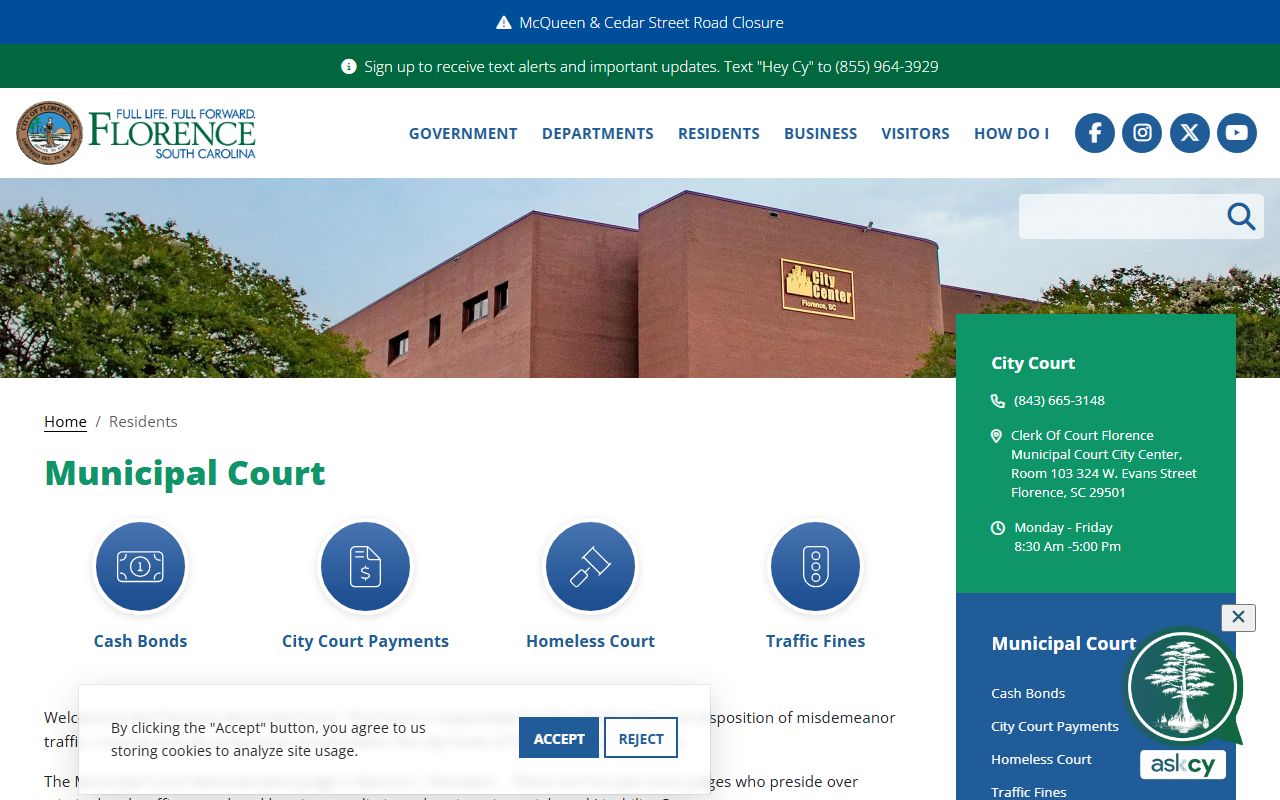
The Florence Municipal Court website provides details about court sessions, payment options, and procedures for handling bench warrants in the city.
Note: Jury trials are one of the functions of the Florence Municipal Court. Missing a jury trial date is treated very seriously and almost always results in a bench warrant being issued immediately.
How Florence Issues Bench Warrants
A bench warrant is a process from the bench. The judge signs it, and it goes to law enforcement for service. In Florence, three situations commonly lead to a bench warrant. Failure to appear is the most frequent. Failure to pay is next. Being tried in absence is the third. Each of these gives the judge reason to order the person's arrest so they can be brought to court.
South Carolina law provides some flexibility in how courts handle missed appearances. Under S.C. Code Section 22-5-115, the judge may choose to issue a summons instead of a bench warrant. A summons gives the person a new date to appear without the threat of immediate arrest. Whether the Florence Municipal Court issues a bench warrant or a summons depends on the specific case, the offense type, and the person's track record with the court.
The legal procedures governing bench warrants in Florence fall under Title 17, Chapter 13 of the South Carolina Code. The Summary Court Bench Book provides guidance to judges on proper procedures for issuing and managing bench warrants in municipal courts like Florence's.
For traffic violations, a bench warrant carries extra weight. The court can report the failure to appear to the DMV. A license suspension may follow. This adds urgency to resolving traffic-related bench warrants in Florence as quickly as possible.
Searching Florence Warrant Records
The Florence County Public Index is a free online search tool. It covers all courts in Florence County. You can look up records by name or case number. Results include case details, charges, and hearing dates. This is the fastest way to check for a bench warrant in Florence without making a phone call.
The statewide court records search from the South Carolina Judicial Branch also covers Florence. Both tools are free and do not require you to create an account. For more targeted results, use the Florence County index since it focuses on local courts.
The Florence County Sheriff's Office may also have information about active bench warrants. Law enforcement agencies in South Carolina share warrant data through systems maintained by the South Carolina Law Enforcement Division. A bench warrant from Florence is visible to officers across the entire state.
Under the South Carolina Freedom of Information Act, court records and warrant information are generally available to the public. You can file a FOIA request with the court or law enforcement. Agencies have 10 business days to respond, with a possible 10-day extension when more time is needed.
Calling the Municipal Court directly is another option. Staff can tell you whether a bench warrant exists for a specific person. Be cautious about appearing in person if you think you may have an active bench warrant, as law enforcement at the courthouse could take you into custody.
Bond Hearings in Florence
After an arrest on a bench warrant in Florence, the person is brought before a judge for a bond hearing. The judge decides whether to grant bond and what amount to set. Under S.C. Code Section 38-53-70, a bail bond remains valid for 90 days after posting. If the case is not resolved within that time, the bond may expire and a new one could be required.
The Florence County Magistrate Court at 184 North Irby Street handles cases outside city limits. You can reach that court at (843) 665-0031. If your bench warrant came from a county-level case rather than the Florence Municipal Court, the magistrate court handles the bond hearing and case resolution instead.
Family court bench warrants in Florence follow Rule 13 of the South Carolina Family Court Rules. These warrants must be used sparingly. A person arrested on a family court bench warrant must see a judge within 24 hours. This applies to Florence County Family Court cases.
Resolving Florence Bench Warrants
Taking action early is the best approach. Contact the Florence Municipal Court to ask about your case and find out what steps you need to take. An attorney can sometimes arrange for a voluntary appearance, which may result in more favorable treatment than being picked up on the bench warrant by police.
Common steps to resolve a bench warrant in Florence:
- Call the Municipal Court to check your case status and upcoming dates
- Speak with an attorney about your options before appearing
- Appear at court voluntarily to address the bench warrant
- Post bond if the judge requires it at the hearing
- Pay any outstanding fines and complete all court requirements
The City of Florence website provides general city information and links to court and public safety services.
Florence County Bench Warrants
Florence is the county seat of Florence County. Bench warrants issued by the Municipal Court are part of the Florence County judicial system. For information about county-level bench warrants, magistrate court details, and other public records, visit the Florence County page.
Nearby South Carolina Cities
Other cities in the region have their own municipal courts and bench warrant processes. Select a nearby city for more information.